An independent guide · not an installer
Solar Panel Installer Runcorn: an independent guide to solar on pitched and flat roofs
Runcorn was designated a New Town in 1964, and nearly four in ten of its homes went up between 1965 and 1982. Most have pitched roofs; some also have a flat-roofed garage, extension or dormer. This guide covers both, with a planner for the flat roofs most solar advice skips.
Runcorn solar, by the numbers
- 943
- kWh a year per kW, south roof at 35°
- 856
- kWh per kW, flat roof at 10°
- 39.2%
- of Runcorn's homes built 1965 to 1982
- 0.6 m
- most a flat-roof array may stand without permission
PVGIS 5.3 for Runcorn; HMRC council tax records (our sum for Runcorn); GPDO Part 14 as amended in August 2026.
Flat roofs: lower, closer, more
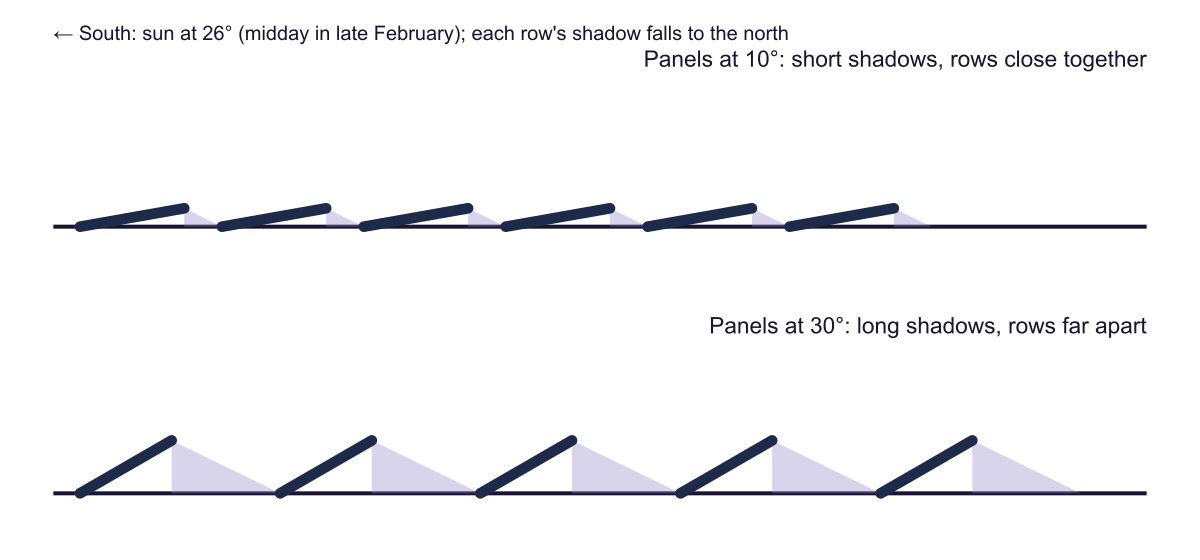
On a flat roof you choose the panels' angle and direction, and the obvious choice, tilting them steeply towards the south like a pitched roof, is usually wrong. Steep rows throw long shadows, so they must stand far apart, and they quickly break the 0.6 m height limit for permitted development.
Low tilts fit far more. On an 8 m by 5 m roof, with rows spaced to stay clear of each other from late February, the flat-roof planner fits 12 example panels at 10 degrees against 8 at 30, and the 10-degree array makes more in a year: about 4,518 kWh against 3,294.
Runcorn's homes and their roofs
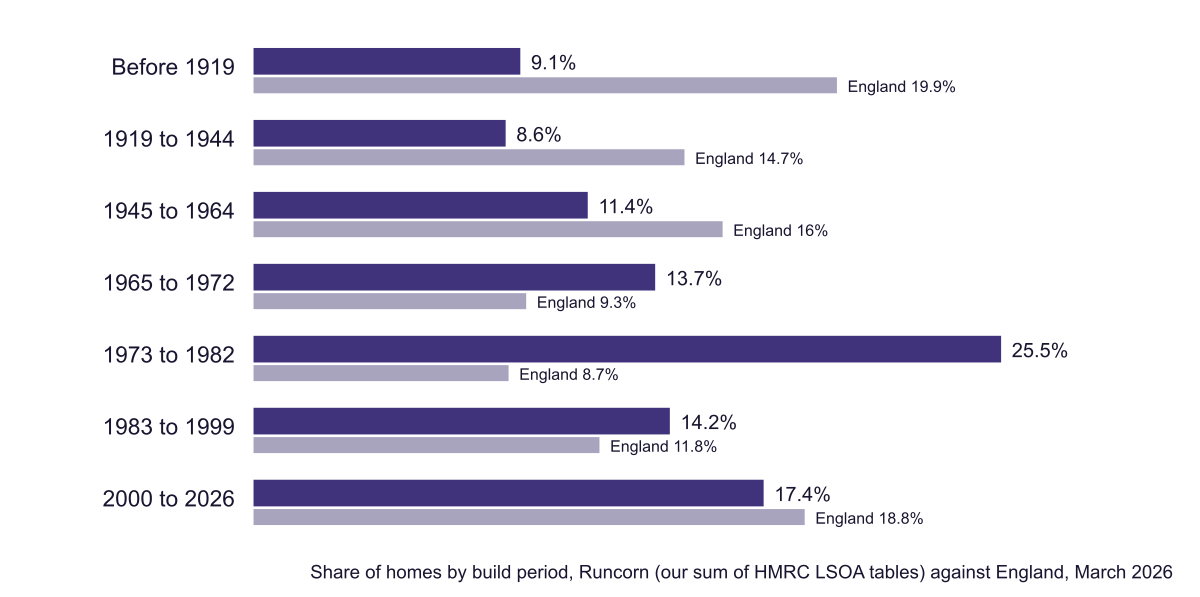
Runcorn grew fast after it was designated a New Town on 10 April 1964: our sum of council tax records puts 39.2% of its homes in the years 1965 to 1982, against 18.0% across England. In the 2021 Census, 35.9% of households in the Runcorn built-up area lived in a terrace and 33.5% in a semi, and 28.6% rented from a social landlord, well above the national share.
New Town homes
Radburn-style estates from Halton Brook in 1966 to Murdishaw and Windmill Hill in the later 1970s, and what their roofs mean for panels.
Extensions, garages, dormers
Small flat roofs that can carry panels facing any way you choose.
Flat or pitched?
What each makes per panel and per roof, from PVGIS for Runcorn.
Runcorn in numbers
Homes, ages, energy ratings and panels fitted so far.
Who owns the roof often decides the first step. With 28.6% of households in the built-up area renting from a social landlord in 2021, many Runcorn tenants will find that panels depend on the landlord's own programme rather than on anything they arrange themselves. Owners, by contrast, can start with the roof: its direction, its condition and whether part of it is flat.
What the sun gives Runcorn
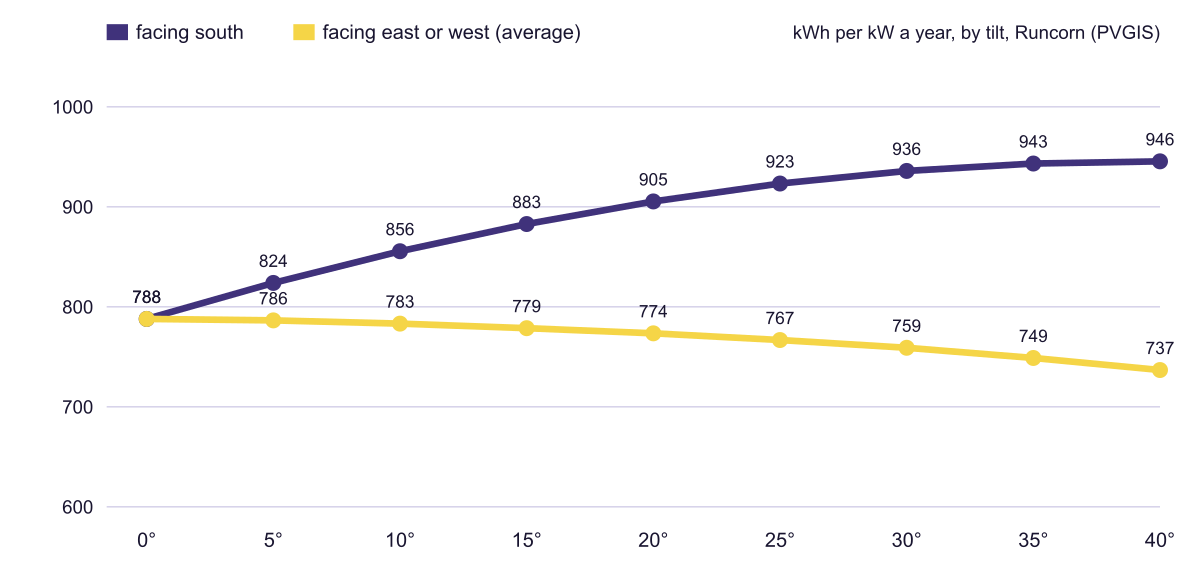
PVGIS, the European Commission's solar model, gives a south-facing roof at 35 degrees in Runcorn about 943 kWh a year for each kW of panels. Tilted at only 10 degrees, as on many flat roofs, a south-facing panel still makes about 91% of that, and an east-west pair about 83%.
Across the town, from the Old Town to Sandymoor, the figure for a south roof varies by well under 1%. Shade and direction matter far more than where in Runcorn you live. See winter sun and row spacing for the sun's height through the year.
The rules in Runcorn
Pitched roofs
Permitted development if the panels stand no more than 0.2 m off the slope and stay below the ridge. See planning rules.
Flat roofs
Permitted development on a house if the array stays within 0.6 m of the roof; prior approval first in a conservation area.
Five conservation areas
Halton Village, Higher Runcorn, Weston Village, Daresbury and Moore are conservation areas; panels on walls facing a road there need permission, and flat-roof arrays prior approval.
The network
Your installer notifies the network operator; larger systems need approval first. See grid connection.
Costs, value and help
Panels are a long-lived asset rather than a running cost: once they are paid for, each unit costs nothing to make, and its worth depends on whether you use it or export it. The money pages show that sum with every assumption on view.
Costs
North West averages of £1,800 per kW up to 4 kW and £1,627 for 4 to 10 kW (DESNZ 2025/26).
Is it worth it?
A first year for pitched and flat roofs, at the current price cap.
Grants and loans
The Warm Homes: Local Grant, run with the city region, lists solar panels for eligible homes rated D to G.
Batteries
Daily output month by month, and how to size one.
Choosing the firm
Plenty of Runcorn households have been through this already. By September 2026, DESNZ counted 2,489 domestic solar installations, 10.05 MW in all, in the Runcorn and Helsby constituency, a seat that takes in Frodsham and Helsby as well as the town. Ask a neighbour with panels which firm they used and what they would do differently, then put that firm through the same checks as any other.
This guide sells nothing, so it can be plain about how to judge those who do. Check the registers, insist on a survey before a price, and on a flat roof ask exactly how the frames will be held down, whether the roof has been checked for the load, and who stands behind the waterproofing afterwards.
- Finding a good installer: registers, the survey, the quote.
- Grid connection: G98, G99 and the paperwork.
- Caring for your panels: monitoring, frames, ballast, cleaning.
- Words explained: ballast, row spacing, kWp and the rest.
More from the guide
- Measuring a flat roof
- Roof coverings
- Winter sun and row spacing
- All guides
- Questions
- Figures and sources
- About this guide
- Contact
Checked against these sources on 3 November 2026: EU JRC PVGIS 5.3: solar output by location, tilt and direction · DESNZ statistics: small-scale solar PV installation costs, 2025/26 · DESNZ statistics: solar photovoltaics deployment (constituency tables) · Legislation.gov.uk: GPDO 2015 Schedule 2 Part 14 (solar on homes) · Legislation.gov.uk: SI 2026/896, solar permitted development changes (27 August 2026) · MCS: The Solar PV Standard (Installation), MIS 3002 v6.0.
Questions from Runcorn homeowners
Is this site a solar panel installer?
No. Solar Panel Installer Runcorn is an independent guide published by SEO-DONS LTD. It does not sell, survey or fit anything, and it does not pass your details to installers.
Can solar panels go on a flat roof in Runcorn?
Yes. On a house, a flat-roof array is permitted development if it stands no more than 0.6 m above the roof. Low tilts work best: on an 8 m by 5 m roof, south rows at 10 degrees fit 12 example panels against 8 at 30 degrees, and make more in total.
How much do solar panels cost in Runcorn?
The 2025/26 North West averages were £1,800 per kW up to 4 kW and £1,627 per kW for 4 to 10 kW (DESNZ). A 3.5 kW system at the regional average is about £6,300.
How much will panels make in Runcorn?
About 943 kWh a year for each kW on a south-facing roof at 35 degrees (PVGIS), about 856 at 10 degrees on a flat roof, and about 783 as east-west pairs at 10 degrees.
Who runs the electricity network in Runcorn?
SP Energy Networks, through its SP Manweb licence. Halton Borough Council's infrastructure plan records the whole borough as on its network, and your installer notifies it about your system.
A flat roof, a quote, or a question about your Runcorn home?
Tell us about the roof or the quote, with your Runcorn postcode. Your message goes to SEO-DONS LTD, the company behind this independent guide, and the reply comes by email. Asking is free and commits you to nothing.
What happens next
- Fill in the form; your postcode tells us which part of Runcorn you are in.
- We look at what you sent and reply by email with the figures and sources that fit.
- Whether you go ahead, and with which firm, is up to you.